
1. Liability of managers, directors, members and legal agents
1.1 Introduction
The Tax Liability arises, at first, from the difference, in Brazilian system, between Direct Taxpayer and Indirect Taxpayer.
In fact, the National Tax Code (CTN) defines the Direct Taxpayer as the taxpayer personally and directly related to the situations giving room to the taxable even, while, on the other side, the Indirect Taxpayer as the individual or company that, without any personal or direct relation to the taxable event, has the tax charged on them by legal provisions.
We should set the premise that the company is an entity with rights and duties that cannot be misunderstood for the ones of individuals or the ones of the companies that are members thereof. Thus, such rights and obligations are limited to the property of such company, as a way of avoiding property commingling and punishments to the individual regularly managing it.
In tax law, the National Tax Code (CTN) allows for, under certain and rigorous conditions, notwithstanding said debt is the company’s, the redirection of the charge to the individual, either a member, officer, director, manager or legal agent of the company.
Such conditions are showed by the combination of the following factors:
1) it is a company subject to delectus personae;
2) the company regularly or irregularly liquidated does not exist anymore;
3) it is not possible to require the compliance with the tax obligation by the direct taxpayer, the company; and
4) there is action or omission by the person in charge, i.e., the one who has management powers over the company, acting in excess of authority, breaks the law or the articles of incorporation/organization, for example, spending the company’s property to their own benefit, not complying with rights and obligations before the company, etc.
There are discussions on the third-party liability being secondary or joint and several. The role of such difference is in the fact that, since the the liability between the company and the individual indirect taxpayers is deemed as joint and several, the tax entity can direct its charge, at first, to any one of them. On the other hand, since it is deemed as secondary, the tax entity can, at first, charge the debt to the company and, in case of possible success, direct the charge to the individual indirect taxpayers.
Brazilian courts, most of the time, treat the liability as secondary. However, it needs to be said that there are decisions that qualify the third-party liability as joint and several, i.e., they put the principal debtor – the company – and the indirect taxpayer at the same level, with the choice of which one of them should be charged for the performed obligation up to the creditor.
The difference carried out by the precedents, in order to treat the liability as being secondary or joint and several, is intrinsically related to situations in which the irregular dissolution of the company is showed, i.e., when the company stops working in its tax domicile without the duly information to the relevant bodies.
In any case, either secondary or joint and several, the third-party liability shall always depend on a commission or omission by the indirect taxpayer, i.e., the performance of an action for which they did not have powers or that represents a breach of the laws, the articles of incorporation or organization, in addition to the company’s irregular dissolution mentioned above.
On this aspect, it is important to highlight that, although the nonpayment of taxes can be superficially seen as a way of not complying with the tax laws, there is a firm understanding of such situation not being reason, sufficient in itself, to lead to tax charge. It is so provided in the precedent of the Superior Court of Justice no. 430:
“Precedent 430/STJ: The noncompliance with the tax obligation does not generate, in itself, the joint and several liability of the managing member”.
Then, the liability can only be characterized if, together with the noncompliance with the obligation, the indirect taxpayer has been proved to intend to perform actions against the law, the articles of incorporation or organization.
We can also recall the intention to perform an action against the laws or the articles of incorporation or organization must be proved by the tax authority through robust and sufficient evidences.
In addition, other characteristic inherent to the liability herein is: to be liable, the third party needs to have management powers, i.e., they must be a qualified third party, who is liable for debts incurred during its office, either they are or not in it, at the time of the charge.
Thus, a certain manager cannot be liable for taxable events that took place before their management. The reason for this, as we said, is that the liability by the manager can only be admitted in the cases in which they worked in excess of authority, braking the laws or the articles of incorporation, at the moment or period of their work before the company.
We shall now briefly analyze the liability of individuals in cases in which the company hypothetically stops operating, either for irregular dissolution or bankruptcy, since those are very common situations and they always lead to concerns by the managers.
1.2 Irregular dissolution of the company
The irregular dissolution of the company is set, as we mentioned above, when the company stops working in its domicile, without the duly information to the relevant bodies. This is what is provided in the Precedent 435 of the Superior Court of Justice, on this subject:
“An irregularly dissolved company shall be deemed as the one that stops working in its tax domicile, without the information to the relevant bodies, giving room to the redirection of the tax foreclosure to the managing member. (Precedent 435, FIRST SECTION, decision 14/04/2010, DJe 13/05/2010)”
Regarding this point, it is important to mention two Themes that were judged by the STJ about irregular dissolution and the imputation of tax liability to partners and non-partners of the company.
For Theme 962/STJ (REsps nºs. 1377019/SP, 1776138/RJ, 1787156/RS), the following thesis was established:
“The redirection of tax foreclosure, when based on the irregular dissolution of the executed legal entity or the presumption of its occurrence, cannot be authorized against the partner or non-partner who, although exercising management powers at the time of the taxable event, did not engage in acts with excess of powers or violation of the law, the articles of incorporation, or the bylaws, and who regularly withdrew from the company and did not cause its subsequent irregular dissolution, according to art. 135, III, of the CTN (National Tax Code).”
As for Theme 981/STJ (REsp nºs. 164533/SP, 1643944/SP, 1645281/SP), the following thesis was established:
“The redirection of tax foreclosure, when based on the irregular dissolution of the executed legal entity or the presumption of its occurrence, can be authorized against the partner or non-partner, with management powers on the date when the irregular dissolution is configured or presumed, even if they did not exercise management powers when the taxable event of the unpaid tax occurred, according to art. 135, III, of the CTN.”
Regarding Theme 962/STJ, the focus is on the liability of the partner or non-partner with management powers at the time of the occurrence of the unpaid taxable event. As for Theme 981/STJ, the focus is on the liability of the partner or non-partner with management powers at the time when the irregular dissolution was configured, regardless of the actual exercise of management at the time of the occurrence of the unpaid taxable event.
Thus, the conclusion of the STJ regarding Theme 962 is that the managing partner cannot be held liable although exercising management powers at the time of the taxable event, as long as they did not engage in acts with excess of powers or violation of the law, the articles of incorporation, or the bylaws, and regularly withdrew from the company without causing its subsequent irregular dissolution.
For Theme 981, the STJ concluded that tax liability may fall on the partner or non-partner, with management powers on the date when the irregular dissolution is configured or presumed, even if they did not exercise management powers when the taxable event of the unpaid tax occurred.
The interpretation of both themes is that they are complementary, as for the STJ, the conditions of liability or not, in the tax sphere, are:
a) No occurrence of acts with excess of power or violation of the law: evidence that the partner or non-partner engaged in acts with excess of powers or violation of the law, the articles of incorporation, or the bylaws – if there is no evidence of harmful acts, there is no basis for imputing liability;
b) Regular withdrawal from the company: The partner or non-partner who proves their regular withdrawal from the company, without contributing to the irregular dissolution, cannot be held liable, regardless of whether they exercised management powers at the time of the taxable event of the debt, and;
c) Remaining in management during the irregular dissolution: The partner or non-partner who remained in the company as an administrator or partner at the time of the irregular dissolution will be held liable, even if they did not exercise management powers on the date when the taxable event of the unpaid tax occurred. What matters is their presence in management during the irregular dissolution.
It is important to mention that the STJ is much stricter in situations where the irregular dissolution of the company is configured, as the discussed themes (981 and 962) penalize any administrator at the time of the dissolution, even if they were not in the company at the time of the occurrence of the taxable event. This is because irregular dissolution is repudiated by the jurisprudence and the legal system, being equated to a true tax fraud.
We should note a very reasonable reading of the precedent contents is that, in order to the irregular dissolution of the company to be characterized, there is no need for the company to effectively stop working; it only needs to change its address without the due information to the relevant bodies, such as the Federal Revenue Service, the State Finance Bureau, the Local Government where it is enrolled, etc.
It should also be noted that the STJ in Theme 630 (Special Appeal No. 1,371,128/RS), extended the effects of the aforementioned Precedent 435, holding that dissolution is irregular, with respect to non-tax claims, when the company ceases to operate at its tax domicile without notifying the competent authorities. In such circumstances, the irregular dissolution gives rise to the redirection of the tax enforcement proceeding against the company’s officers, both in the event of non-payment of tax and non-tax claims.
Another fundamental point to which we call attention is the evidence in the records that the company was irregularly dissolved, with some decisions by the STJ, it shows the simple certification by the marshal in the tax foreclosure procedure saying they did not find or the company did not exist at the place for summons, would be enough to set the irregular dissolution of the company and authorize the redirection of the tax foreclosure to the manager [1].
1.3 Tax foreclosure redirection
Once the tax nonpayment is verified, and after the needed procedures, the creditor can extract the certificate of overdue tax liability – out-of-court cause to ground the filing of a tax foreclosure suit, instrument that can require the debtor to meet their obligation.
When there is no property that can undergo expropriation by the creditor, to pay the debt, and in case of the hypothesis provided for in tax laws, i.e., the performance of actions against the law, the articles of incorporation or in excess of authority, in addition to the irregular dissolution of the company, the judgment creditor can claim, before the judge, the redirection of the executive claim, in order to enforce the rule on third-party charging provided for in the articles above, by the CTN (National Tax Code).
This refers to the possibility that, during the tax enforcement directed at the corporate taxpayer, the assets of individuals who were originally not part of the enforcement’s passive subject can be reached, due to having committed acts with excess of powers, violation of the law, or the constitutive acts.
It is emphasized that “The mere non-payment of the tax does not, by itself, even theoretically, constitute a circumstance that entails the subsidiary liability of the partner, as provided for in art. 135 of the CTN (National Tax Code). It is essential, for this purpose, that they have acted with excess of powers or violation of the law, the social contract, or the company’s statute”1.
Regarding this aspect, the national precedents has always understand the creditor, in case of no property found, cannot simply request the redirection of the tax foreclosure to the indirect taxpayer. They must, before it, prove the hypothesis provided for in the laws as authorizing the individual liability.
Such situation, nonetheless, is not fully admitted when, although the tax foreclosure is filed only against the company, the name of the member is in the CDA (overdue liabilities certificate). In such hypothesis, the indirect taxpayer should prove they did not perform any continuing crime, excess of authority or violation to the articles of incorporation.
In such aspect, the unduly liable individual shall use procedural means needed to their defense, as, according to what we affirm herein, except for the hypothesis of irregular dissolution, which also depend on evidences – certificate by the marshal proving the company does not work at the place in its registry before public bodies anymore, for example – the tax foreclosure redirection is not automatic.
Although there is no express provision regarding the deadline for redirecting tax enforcement against directors, the five-year period provided for in Article 174 of the National Tax Code (CTN), used for filing tax enforcement after the definitive constitution of the tax credit, is considered applicable to the individuals mentioned in Article 135 of the CTN (National Tax Code).
Regarding the starting point of this period, it is generally the date of the service order on the taxpayer company in the tax enforcement. However, in cases where the fraudulent act is committed after the service on the company in the enforcement proceeding, the Superior Court of Justice (STJ) stated that “it is the date of the unequivocal act indicating the intent to render the satisfaction of the tax credit already under executive collection promoted against the taxpayer company unfeasible, to be demonstrated by the Tax Authority”2.
Although the Superior Court has clarified the temporal milestones, there are still uncertainties about what constitutes an “unequivocal act” that prevents the satisfaction of the credit by the Public Treasury.
Lastly, it is important to note a recent single-justice decision of the STJ recognizing that a tax enforcement proceeding cannot be redirected against the partners of a company that had been duly dissolved before the tax enforcement action was filed. This is Special Appeal No. 2,259,198/SP, reported by Justice Paulo Sergio Domingues, who held that the Superior Court’s settled case law provides that, where a tax enforcement action is brought against a legal entity that had already ceased to exist at the time the tax debt was registered as outstanding public debt, and the claimant Tax Authority had full knowledge of such dissolution, a request to redirect the action against a partner amounts to an attempt to substitute the liable party named in the enforceable instrument. Such substitution is barred by STJ Precedent 392.
Accordingly, this precedent is of significant value to taxpayers, as it prevents the Tax Authorities from attempting to cure inherent defects in the original issuance of the Certificate of Outstanding Tax Debt (Certidão de Dívida Ativa – “CDA”).
1.4 Bankruptcy
Technically, bankruptcy is a legal and procedural judicial regime that, through a judgment, aims at the collective foreclosure of property of the debtor that cannot pay their debts. In such regime, the creditors seek, through the divisions of the property owned by the one undergoing bankruptcy, a way to pay the debts, according to certain rules set by law.
With the in-court adjudication of bankruptcy, the estate is formed – a true universality of rights – that starts to be liable for the debt in lieu of the company originally being charged.
Although one of the basic principles of the bankruptcy proceeding is, through the start of a bankruptcy case, assuring equitable conditions between creditors with the same nature, we need to recognize the laws in force provide for the preference of some credits before others, with such distinction based on public interest.
Thus, tax liabilities are privileged, as they must be payed in preference to others, except for credits arising from labor law or work accident and credits with collaterals at the limit of the value of the encumbered property.
We should, however, consider the tax credit is not included in the bankruptcy case and it is subject to allowance, so as the tax foreclosure pends independently of bankruptcy and its adjudication does not interrupt the tax foreclosure, as per the understanding of our courts.
On such aspect, it is important to mention the tax foreclosure, at first, continues against the estate. If, at the end, the property in the estate are not enough to pay the tax debts of the former company, its officers, members, agents and managers are not automatically liable, except if the hypothesis herein are verified.
Thus, without the characterization of the irregular dissolution of the company, its closing due to the adjudication of bankruptcy does not automatically generate the liability of the members, officers, managers and agents of the company, except the tax authority shows the performance of actions against the law, the articles of incorporation or in excess of authority.
On the other hand, it is important to note that, in a July 2026 decision in AgInt in Special Appeal No. 2,165,948/RJ, the STJ held that a subsequent bankruptcy order has no retroactive effect capable of rebutting a previously established presumption of irregular dissolution—particularly where the factual record indicates that the company could not be located even at the new address reported to the bankruptcy court. The Court further held that notifying only the judicial reorganization court of a change of address, without a corresponding update with the Tax Authorities and the relevant registries, does not, in itself, rebut the presumption of irregular dissolution under STJ Precedent 435 [2].
Accordingly, where an irregular dissolution is found to have occurred before the bankruptcy order, the tax enforcement proceeding may be redirected against the legal entity’s partners, directors, officers, and representatives.
1.5 Changes Introduced by Complementary Law No. 214/2025
In early January 2025, the Complementary Law No. 214 of 2025 was enacted, establishing the new consumption taxes resulting from the Tax Reform, namely: the Tax on Goods and Services (IBS), the Social Contribution on Goods and Services (CBS), and the Selective Tax (IS).
In addition to regulating these taxes, the Complementary Law also introduced specific provisions regarding third-party liability. However, it explicitly stipulates that the provisions of the National Tax Code (CTN), as commented on above, are not superseded by the enactment of this new law.
Generally speaking, the Supplementary Law innovates by expressly listing a set of actions that may give rise to joint and several liability of third parties. Meanwhile, Article 124, subsections I and II, also of the National Tax Code, in a separate chapter, provide that persons with a common interest in the situation that constitutes the taxable event, as well as persons expressly designated by law, are jointly and severally liable.
As a side note, Article 128 of the CTN provides that a third-party liable person must be directly connected to the taxable event giving rise to the obligation. Meanwhile, Article 124, items I and II, in a separate chapter of the CTN, establishes that individuals or legal entities with a common interest in the situation that constitutes the taxable event, as well as those expressly designated by law, are jointly and severally liable.
It can be observed that the CTN does not confuse third-party liability with the concept of joint and several liability. This is because the latter is not a form of selecting a liable taxpayer but rather a plurality of people with a common interest in the situation or by virtue of law. Therefore, these provisions must be interpreted together when dealing with third-party liability on a joint and several basis.
“The provision under Article 124, II, which states that ‘persons expressly designated by law’ are jointly and severally liable, does not authorize the legislator to create new cases of tax liability without observing the requirements set forth in Article 128 of the CTN.”
(Excerpt from the leading opinion of Justice Ellen Gracie in RE 562.276, in 2010)
For this reason, there may be considerable confusion in interpreting Complementary Law No. 214/2025, as it tends to treat distinct legal concepts as if they were one and the same.
Specifically, items I, II, and VI of the new law impose liability on individuals or legal entities that participate, under any title, in transactions not supported by proper tax documentation. Item IV imposes liability on those who develop or supply software designed to circumvent tax legislation. Finally, item V addresses those who conceal the occurrence or value of a transaction or who abuse the legal personality to evade tax obligations.
The logic adopted by the legislator may be summarized as follows: any party participating in such conduct is deemed to have contributed to the harm caused to the public treasury and may therefore be held liable for the non-payment of taxes.
By providing these provisions, the tax authorities effectively compel all parties involved in a transaction to monitor one another’s compliance with documentation and legal standards, as a means of avoiding personal liability.
The implementation of this joint and several liability framework will undoubtedly pose new challenges to entities throughout the production and supply chain, particularly with regard to the need for operational adjustments and more stringent control over commercial transactions.
Although the enforcement of tax obligations remains within the exclusive purview of the tax authorities, the imposition of joint and several liability will require companies and individuals to play a more active role in ensuring the tax compliance of their commercial partners.
2. Stages at which tax and tax-crime liability may arise – how collection reaches the individual
This section describes the path at federal level. States and Municipalities follow a similar logic, but each of the 27 federative units and each of the more than 5,500 municipalities has its own legislation, which must be checked case by case.
2.1 Administrative stage: attribution of liability, defense and asset measures
Liability may be attributed to third parties in the tax assessment notice (auto de infração) itself, in a decision denying an offset claim, in the course of the tax administrative proceeding or even after it has closed (a procedure governed by Normative Instruction RFB No. 1,862/20183).
Attribution is not limited to assessment notices: it also reaches offsets declared by the taxpayer and not approved by the tax authorities, a frequent situation in groups with significant tax credits.
Once liability is attributed, the company and the individuals file separate defenses. There are no court costs and no collateral requirement at this stage. The person held liable may challenge both the attribution of liability and the merits of the tax demand – and should do so, because raising the issue later is more costly.
In parallel, the authorities may adopt two asset-related measures:
- Asset listing (arrolamento de bens) – an asset-monitoring measure that applies where the tax debts simultaneously exceed 30% of the taxpayer’s known net worth and the statutory threshold in force (article 64 of Law No. 9,532/1997, with the amount set by regulation). It does not prevent the sale of the assets, but it requires notice to the tax authorities and affects their liquidity. It is not open to an administrative defense; it may be challenged in court.
- Tax precautionary measure (medida cautelar fiscal) – a more aggressive court measure (Law No. 8,397/1992), available where there are indications that the debtor is seeking to frustrate collection: no fixed domicile, dissipation of assets, disproportionate indebtedness, transfer of assets. It may result in the freezing of the assets of those held liable, even before the tax foreclosure proceeding (execução fiscal – the judicial procedure by which the government collects registered tax debts) begins.
2.2 The ruling and its possible outcomes
The administrative dispute runs through two levels. The second is decided by a joint panel (CARF) made up of representatives of the tax authorities and of taxpayers. Two rules in force since Law No. 14,689/2023 have a direct effect on personal risk:
- A tie is broken by the casting vote (voto de qualidade), cast by the chair of the panel, who is a representative of the National Treasury.
- Where the case is decided by the casting vote in favor of the Treasury, the penalties are cancelled and the tax representation for criminal purposes (representação fiscal para fins penais) is withdrawn. Late-payment interest is also cancelled if the taxpayer states its intention to pay within 90 days.
The second rule is decisive: an unfavorable administrative outcome decided by the casting vote removes the referral of the case to the Ministério Público (the public prosecution service). This is the only point in the system where a tax defeat produces express protection on the criminal side.
The close of the administrative dispute has three possible outcomes:
- Fully favorable decision – extinguishes the tax debt and, with it, the liability of the individuals, bringing asset measures and related criminal procedures to an end.
- Decision favorable only as to personal liability – the demand remains against the company (in whole or in part); the officer is no longer pursued and the restrictions in his or her name are lifted.
- Unfavorable decision – the debt is entered in the registered tax debt roll (dívida ativa) and the dispute may be taken to the courts, both on the merits and as to liability.
2.3 Between the end of the administrative proceeding and the tax foreclosure proceeding
Two procedures may bring individuals in during this interval:
- Late attribution of liability by the Receita Federal (the federal tax authority), after the final decision and before entry in the registered tax debt roll. The procedure is governed by Chapter III of Normative Instruction RFB No. 1,862/2018, under which the person held liable is served with a Notice of Attribution of Tax Liability (Termo de Imputação de Responsabilidade Tributária), has a period in which to file a defense and may appeal, but the appeal is decided at a single level and does not suspend collection.
- Administrative Procedure for the Recognition of Liability (PARR – Procedimento Administrativo de Reconhecimento de Responsabilidade), conducted by the Procuradoria-Geral da Fazenda Nacional (PGFN – the National Treasury Attorney General’s Office, which manages and collects registered tax debt) in cases of suspected irregular dissolution. A defense may be filed within 15 days and an appeal within 10 days, neither of which suspends collection.
In practice: Deadlines of this order, counted in days, are incompatible with the approval chains of a foreign parent company. It is advisable to define in advance who, in Brazil, has authority to instruct the defense without prior consultation abroad.
2.4 Court stage and redirection of liability
Once the debt is registered, collection proceeds by way of a tax foreclosure proceeding. An individual may be brought in in two ways: by already appearing on the registered tax debt certificate (CDA – certidão de dívida ativa), or by later redirection.
The distinction is decisive as to the burden of proof:
- Name on the CDA – the certificate enjoys a presumption of certainty and enforceability. It is for the officer to prove that he or she did not engage in the conduct that triggers liability (a position settled by the Superior Tribunal de Justiça (STJ – the Superior Court of Justice) in a binding repetitive-appeal ruling, Theme No. 103).
- Name not on the CDA – it is for the tax authorities to demonstrate the statutory ground. The mere absence of assets in the company does not authorize redirection.
As to the time limit, although there is no express rule, the five-year period of article 174 of the Código Tributário Nacional (CTN – the National Tax Code) applies. As a rule, time runs from the order directing service of process on the company; where the fraudulent act comes later, time runs from the date of the unequivocal act of frustrating collection, which the tax authorities must demonstrate (STJ, Theme 444). What amounts to such an “unequivocal act” still has no precise contours.
One relevant limitation on the tax authorities is worth noting: replacement of the registered tax debt certificate is allowed in order to correct a material or formal error, but not in order to change the taxpayer against whom it is issued (Súmula 392/STJ – a consolidated precedent of that court). The inclusion of officers by way of a mere amendment to the certificate is therefore open to challenge.
The available defenses are the objection to enforcement (exceção de pré-executividade – a motion available for matters that require no evidentiary phase and that does not call for collateral, Súmula 393/STJ) and the enforcement defense (embargos à execução), which requires full collateral. Absent voluntary collateral by court deposit, surety bond or bank guarantee, the Treasury will seek to attach the assets of all persons held liable.
The most frequent lines of defense are: no irregular dissolution occurred; a regular departure before the company was wound up; no management powers; the statute of limitations; regular winding-up through bankruptcy; and the absence of an economic group or of commingling of assets.
2.5 Bankruptcy and court-supervised reorganization
As already addressed in a chapter above, a duly declared bankruptcy is not an irregular dissolution. Winding up the operation through the courts, transparently, defeats the presumption of Súmula 435 and is, from the standpoint of personal risk, preferable to abandoning the company.
Once bankruptcy is declared, the bankruptcy estate (massa falida) is formed and becomes liable for the debts. Tax debts are not subject to filing in the creditors’ ranking proceeding, and the tax foreclosure proceeding is not terminated by the bankruptcy – although acts of attachment and sale of assets are coordinated with the bankruptcy court, under the system introduced by Law No. 14,112/2020.
In the ranking of claims, tax claims come after labor claims (up to the statutory limit) and after claims secured by security interests in property. Tax penalties rank below the tax itself.
If the estate’s assets are insufficient, partners and officers are not automatically liable. Liability still requires proof of a breach of the law, an act in excess of powers or a violation of the articles of association.
Note, however, the restriction introduced in 2026: a taxpayer declared a habitual tax defaulter (devedor contumaz – a taxpayer that systematically and deliberately fails to pay taxes as a business strategy, as opposed to one facing temporary financial difficulty) is barred from applying for court-supervised reorganization or from continuing one already filed, and the public treasury may request its conversion into bankruptcy liquidation (item 3 below).
It is also worth noting that the STJ has extended this regime to non-tax liabilities: in a tax foreclosure proceeding for registered debt, whether tax or non-tax, where the company has been irregularly dissolved, redirection against the managing partner is available with no requirement of intent (STJ Theme 630, REsp 1,371,128/RS, 1st Section, 2014). The characterization therefore covers any debt entered in the registered tax debt roll, whether social security or of another nature.
3 Note to the reader: We advise verifying whether this or any other legislation referenced in this article remains in force at the time of consultation.
3. The habitual tax defaulter (devedor contumaz) regime (Complementary Law No. 225/2026)
Enacted in January 2026, Complementary Law No. 225/2026 created the Taxpayer Bill of Rights (Código de Defesa do Contribuinte) and, in the same statute, a severe regime for the so-called habitual tax defaulter. It is the most significant change since the last edition of this guide and alters assumptions that, until 2025, were treated as settled.
At federal level, the qualification criteria and the procedural rules were detailed by Joint Ordinance RFB/PGFN/MF No. 6 of March 26, 2026, which is the source of the parameters described below.
The logic of the law is to separate two profiles: the taxpayer going through financial difficulty and the taxpayer that makes non-payment of taxes part of its business model. From the latter, benefits are withdrawn – including criminal ones.
3.1 Qualification
Qualification presupposes default that is substantial, repeated and unjustified, established in an administrative proceeding in which the taxpayer is heard and which results in a final administrative decision. At federal level, the law sets objective monetary parameters – debts of a high amount, in the order of R$ 15 million, exceeding the debtor’s known net worth. States, the Federal District and Municipalities retain the power to set their own criteria.
The federal regulation also set the remaining criteria. Default is repeated where there are irregular debts in at least four consecutive assessment periods, or in six non-consecutive ones, within twelve months. Known net worth corresponds to the total assets reported in the latest balance sheet filed in the Escrituração Contábil Fiscal (ECF – the annual tax accounting return) or in the Escrituração Contábil Digital (ECD – the digital accounting bookkeeping filing).
The procedure is adversarial and follows a defined sequence: prior notice identifying the debts and the grounds; thirty days in which to cure the default or file a defense, which has suspensive effect; an appeal within ten days, also with suspensive effect; and a final decision at the administrative level. Suspensive effect is withheld in the most serious situations – fraud in the incorporation of the company, participation in an organization aimed at frustrating collection, management through nominees, non-existence in fact at the tax domicile, concealment of assets – but only where these have already been recognized in a final administrative decision or in a final and unappealable court decision.
Not every liability is counted. Deducted from the total are debts whose enforceability is suspended by court order, debts registered in the tax debt roll with suspended enforceability, debts subject to a moratorium, an installment program or a tax settlement with payments up to date, debts based on a relevant and widespread legal controversy, and debts raising an issue admitted to the repetitive appeals procedure. Amounts exempted from collateral under Law No. 14,689/2023 are also deducted.
The practical consequence matters for litigation planning: litigating with enforceability suspended is no longer merely a cash-flow decision. It now operates as protection against qualification itself.
Recommended action: the defense in the qualification procedure may rely on objective elements known in advance – evidence of payment, of a settlement, of a full court deposit or of adequate collateral; updating of known net worth by filing or amending the ECF or the ECD; losses in the last two financial years; and proof that there was no fraud against enforcement. This last item has a direct effect on current corporate decisions: the distribution of profits and dividends, the payment of interest on net equity, capital reductions and the granting of intercompany loans all weigh against the taxpayer in this assessment.
3.2 Tax and operational consequences
Qualification is formalized by an Executive Declaratory Act of the Receita Federal or by an Ordinance of the PGFN, depending on the nature of the debts, and subjects the taxpayer, individually or cumulatively, to the following measures:
- A bar on enjoying any tax benefits, including debt forgiveness and amnesty.
- A bar on using tax loss carryforwards or negative CSLL tax base credits to settle taxes.
- A bar on taking part in public tenders.
- A bar on entering into any form of relationship with the public administration – authorizations, licenses, accreditations, concessions and grants of rights. Contracts already in force are preserved in the case of providers of essential public services and operators of critical infrastructure.
- A bar on applying for court-supervised reorganization or continuing an existing one, with conversion into bankruptcy liquidation at the request of the Procuradoria-Geral da Fazenda Nacional.
- A declaration that the CNPJ registration (the federal corporate taxpayer registry) is inactive for as long as the conditions that justified qualification persist.
- Subjection to a single-level administrative litigation procedure.
- A bar on entering into a tax settlement in respect of public treasury claims, whether tax or non-tax.
In the most serious situations – fraudulent incorporation, management through nominees, non-existence in fact at the declared tax domicile, deliberate concealment of assets, revenues or rights – the consequence is more severe: the CNPJ registration is cancelled, and not merely declared inactive, after notice allowing thirty days in which to respond or cure.
Qualification is published in a list maintained on the Receita Federal website, recorded in Cadin (the federal registry of unpaid debts owed to the public sector) and noted on the CNPJ record itself. The reputational effect is therefore immediate and public.
How to exit the situation – and why timing matters
The exit regime differs according to the stage, and the distinction is decisive:
- Before qualification, while the administrative proceeding is under way: full payment ends the proceeding; a settlement covering all debts, with installments paid on time, suspends it. Suspension is denied, however, where deliberate delaying behavior is identified, assessed by factors such as a history of successive installment reschedulings and payment of less than 75% of the debts included in installment programs.
- After qualification: the negotiated route is no longer available, because tax settlements become prohibited. Exit depends on there being no remaining debts sustaining the status and on the debts having been extinguished, or on proof of known net worth equal to or greater than the debts that gave rise to the inclusion. A request for review does not suspend the effects of qualification until a final favorable decision is issued.
In practice: the useful negotiation window closes with qualification. Once the taxpayer is notified, the following thirty days are worth more than all the litigation that comes after – it is the only moment at which paying or negotiating still solves the problem in full.
3.3 Extension to related parties and co-obligors
The consequences described above do not stop at the debtor company. The regulation also qualifies as a habitual tax defaulter any taxpayer whose tax liability has already been recognized, administratively or in court, and that is a related party of a legal entity in two situations: where that entity has been cancelled or declared inactive in the last five years, with irregular debts equal to or greater than R$ 15 million; or where that entity retains the status of habitual tax defaulter.
The concept of related party adopted is the one used in transfer pricing legislation, which is broad – wide enough to reach parent companies, subsidiaries and affiliates, including abroad. The public list of habitual tax defaulters provides for entry by CPF (the individual taxpayer registry number) where the related party is an individual.
The right to be heard is guaranteed: in the liability attribution proceeding, where liability is established after the original debtor’s qualification; or in the qualification proceeding itself, where liability has already been established. If liability comes to be recognized in a court decision issued after the original debtor’s qualification, the effects of the regime extend to the co-obligor, who may request a review.
Why this changes the risk assessment: the redirection dealt with in section 2.4 is no longer the final outcome. Once the tax liability of an officer or of another company in the group is recognized, the possibility opens up of qualification as a habitual tax defaulter – with the operational restrictions described in this section and with the loss of the criminal-relief mechanisms dealt with in the next one. Winding up a Brazilian company with significant tax liabilities irregularly may, through this route, contaminate the group’s other companies and the individuals involved.
3.4 Criminal consequences
This is the turning point. Historically, the Brazilian system allowed payment of the tax to extinguish criminal liability, and an installment program to suspend the State’s power to prosecute. Complementary Law No. 225/2026 withdrew both benefits from anyone declared a habitual tax defaulter in a final administrative decision and recorded in Cadin, amending articles 168-A and 337-A of the Criminal Code, article 34 of Law No. 9,249/1995 and the installment regimes of Laws No. 10,684/2003 and No. 11,941/2009.
Two effects deserve emphasis:
- Irreversibility. Ceasing to be treated as a habitual tax defaulter does not restore the benefit in respect of acts committed during the period of qualification.
- Non-retroactivity. Because this is a more burdensome criminal rule, it does not reach facts prior to the law coming into force. Earlier offenses remain subject to the previous regime.
Risk assessment: For taxpayers generally, regularizing their tax position remains the way out of the criminal problem. For a qualified taxpayer, it is not. This shifts the moment of the defense: the administrative qualification proceeding now carries a direct criminal consequence and cannot be treated as a purely tax dispute.
3.5 The other side of the law
The same statute consolidated taxpayer rights at national level – clear communication, access to the case file, parameters for the conduct of the tax authorities – and formalized tax and customs compliance programs, with differentiated treatment for cooperative taxpayers. The law was enacted with vetoes, which reduced part of the benefits originally provided for good payers. For foreign groups with regular operations, joining these programs is a concrete risk-mitigation instrument.
Joining compliance programs is no longer merely good practice. A taxpayer admitted to the Cooperative Tax Compliance Program (Confia) is not subject to qualification as a habitual tax defaulter for as long as it is not excluded from the program. Conversely, qualification results in the automatic cancellation of the Selo Sintonia (the federal tax compliance seal).
4. Tax-crime liability (criminal aspects)
4.1 The distinction that matters
At the outset, it is important to stress that, under Brazilian law, a tax debt is not a crime, and being included as a co-obligor in a tax assessment does not turn an officer into a defendant. Criminal liability:
- is personal and individualized – it looks at the conduct of each person, not at their position on the organization chart;
- requires intent (dolo) – the intention to evade tax or to appropriate an amount belonging to a third party; error, differences of interpretation and financial difficulty are not enough;
- is determined in separate proceedings, with their own safeguards, independent of the tax proceeding.
Confusion between the two spheres is the main source of anxiety for foreign executives – and, in most cases, it is unfounded.
4.2 The relevant criminal offenses
- Article 1 of Law No. 8,137/1990 – suppression or reduction of tax by fraud: omission of information, false statements, improper documents. These are result offenses, dependent on an outcome.
- Article 2, item II, of the same law – failure to pay over, within the statutory deadline, tax withheld or charged to a third party. This is what is known as tax misappropriation (apropriação indébita tributária).
- Articles 168-A and 337-A of the Criminal Code – misappropriation of social security contributions and evasion of social security contributions.
The order of magnitude of the penalties: imprisonment of two to five years and a fine under article 1; detention of six months to two years and a fine under article 2. Limitation periods and the regime for serving sentences vary according to the offense and must be analyzed case by case.
4.3 Tax declared and not paid
The Supremo Tribunal Federal (STF – the Federal Supreme Court), in RHC 163,334, held that a taxpayer that, habitually and with intent to appropriate, fails to pay over the ICMS – Imposto sobre Circulação de Mercadorias e Serviços (state VAT on the circulation of goods and on certain services) charged to the purchaser commits the offense under article 2, item II, of Law No. 8,137/1990. The STJ has settled that tax misappropriation may occur both in a company’s own transactions and under the tax substitution regime (Súmula 658).
The decision is often read in alarmist terms. Its two qualifying requirements are restrictive:
- Habitual default (contumácia) – repeated and systematic non-payment, a genuine business model rather than an isolated episode. The taxpayer’s compliance record is taken into account.
- Intent to appropriate – established by objective circumstances, such as prolonged non-payment with no attempt to regularize, sales below cost, the creation of obstacles to the tax audit, the use of nominees among the shareholders or the irregular winding-up of activities.
There is a relevant development here: until 2025, “habitual default” was a concept built by case law. With Complementary Law No. 225/2026, there is now a statutory definition and an administrative qualification procedure. Even though the two spheres are formally independent, it is foreseeable that the administrative declaration of habitual default will be invoked as evidence in the criminal sphere – one more reason to treat that procedure as a priority.
4.4 When criminal prosecution may begin
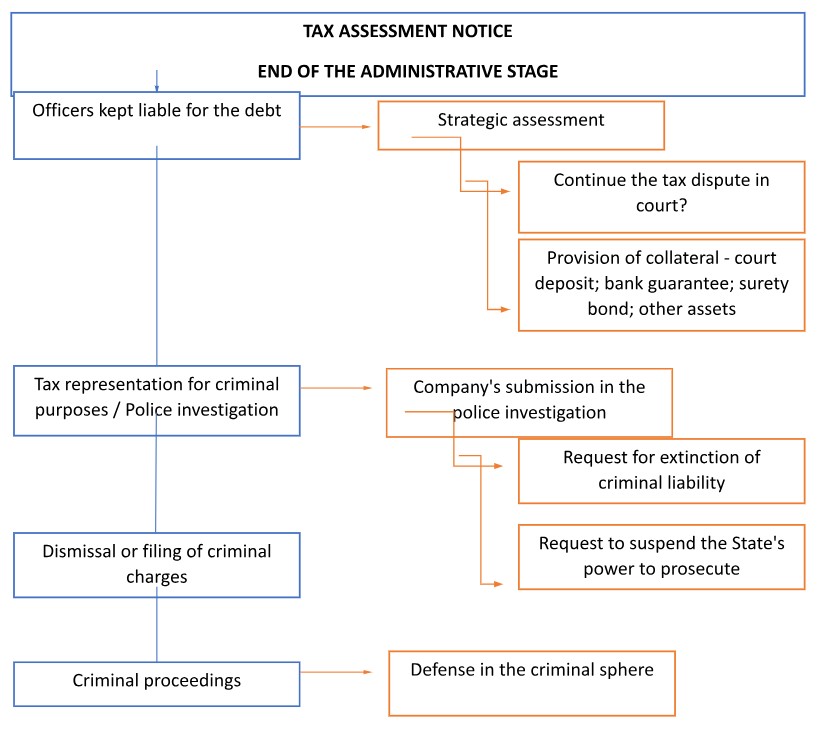
The protective rule is Binding Precedent 24 of the STF (Súmula Vinculante 24): no result offense against the tax system exists before the tax has been finally assessed. In practice, this means that the company has the right to challenge the demand at the administrative level before any criminal charge. The tax representation for criminal purposes is only sent to the Ministério Público after the final administrative decision (article 83 of Law No. 9,430/1996).
This protection, however, has been eroded. The STJ4 has allowed criminal prosecution before the end of the tax procedure in two situations: where the offense charged is a conduct offense – as in the case of failure to issue an invoice (article 1, item V) – and where there is actual obstruction of the tax audit or evidence of related standalone offenses, such as money laundering and criminal organization.
Operational consequence: The premise that “while I am challenging the assessment notice, there is no criminal risk” is no longer safe. Obstructive conduct during a tax audit – refusing to produce documents, evasive answers, claiming that records are unavailable – can bring the criminal sphere forward, with an effect far greater than the tactical gain it produces.
Figure 1 – Typical path of tax litigation and its criminal ramifications
4.5 Exit routes and their current legal limits
- Full payment – extinguishes criminal liability for offenses against the tax system at any time, including after criminal charges have been filed. It does not apply to a qualified habitual tax defaulter.
- Installment payment program – suspends the State’s power to prosecute for as long as it is duly complied with, and suspends the criminal limitation period during that time. To produce this effect, the installment application must have been filed before the criminal charges are accepted by the court (article 83, paragraph 2, of Law No. 9,430/1996, as worded by Law No. 12,382/2011). An installment program applied for after the charges are accepted does not suspend criminal proceedings already under way. If the installment program is breached, the criminal proceedings resume. None of these situations applies to a qualified habitual tax defaulter.
- Tax settlement – negotiation of debts with the Federal Union (Laws No. 13,988/2020 and No. 14,375/2022), with discounts and extended terms according to ability to pay. It is an underused instrument among foreign groups, generally because they are unaware of it. It is prohibited for a qualified habitual tax defaulter, who is also subject to single-level administrative litigation.
- Casting vote – as noted above, an administrative outcome decided by the casting vote cancels the tax representation for criminal purposes.
The choice of collateral in court proceedings also has an indirect effect in the criminal sphere: a full court deposit, because it places the amounts effectively at the State’s disposal, has been successfully invoked in applications to close police investigations, which is not the case to the same extent with a surety bond or a bank guarantee. The decision on collateral should therefore take the criminal scenario into account, and not only the financial cost.
4.6 Related risks
Tax investigations rarely stay within tax law. Charges of false statements, money laundering and criminal organization are commonly brought at the same time – offenses that do not depend on a final tax assessment and that attract more severe precautionary measures. For groups with global compliance programs, the interface with Law No. 12,846/2013 (administrative and civil liability for acts against the public administration) also matters, since those procedures may run in parallel.
4 Conduct offense (article 1, item V): STJ, RHC 209,207/GO (Informativo 865). Obstruction of the tax audit and related offenses: STF, ARE 936,653 AgR.
5. Compliance: what actually reduces exposure
5.1 Registrations and tax domicile
This is the lowest-cost, highest-return measure. The address, the shareholding structure and the officers must be kept up to date at the same time with the Receita Federal, the Junta Comercial (the state commercial registry), the state finance department and the municipal government. Most redirections based on irregular dissolution result from a failure to update registrations, not from an intention to defraud.
Bookkeeping is part of that same maintenance duty. Failure to file the ECF or the ECD, where required, causes known net worth to be treated as zero for the purposes of qualification as a habitual tax defaulter – which, on its own, may establish substantial default, regardless of the assets actually held. This is a typically inadvertent risk, common in subsidiaries with small teams or in the process of being discontinued.
5.2 Authority levels, delegation and documentary trail
Setting out in writing who decides what in tax matters serves two purposes: it prevents error and, when an error occurs, it shows that those who did not decide had no involvement. Minutes, internal policies, legal opinions and approval records are the evidence that supports each officer’s individual defense.
5.3 Protocol for an officer’s departure
Every departure should produce three documents: the corporate act of resignation or removal; the filing with the Junta Comercial and the update of the CNPJ; and formal notice to the group. The departing officer is advised to keep copies of these documents – in any future dispute, the burden of proving the date and the regularity of the departure will fall on him or her, not on the company.
5.4 Winding up operations
No Brazilian operation should be closed in fact before it is closed in law. Where there are significant tax liabilities and the business is no longer viable, the court route – reorganization or bankruptcy – is preferable to abandonment, because it preserves formal regularity and defeats the presumption of irregular dissolution. From 2026 onwards, this planning must also take into account the restriction imposed on habitual tax defaulters as to access to court-supervised reorganization.
There is also a deferred effect to consider. A company cancelled or declared inactive in the last five years, with irregular debts above R$ 15 million, contaminates its related parties whose tax liability comes to be recognized. The badly handled winding-up of a Brazilian operation therefore produces consequences that outlive the company itself.
5.5 D&O insurance and conflicts of interest in the defense
Directors’ and officers’ liability policies should be reviewed as to their coverage of defense costs in tax and criminal proceedings in Brazil, and as to their extension to officers who have already left office.
A sensitive and frequently neglected point: the company and the officer may have divergent interests. The company may prefer to attribute the error to an individual decision; the officer, to a systemic failure. As long as their interests coincide, a joint defense is efficient. Where they diverge, separate representation ceases to be a precaution and becomes a necessity.
Referenced Legislation
1988 Federal Constitution; Law No. 5.172/1966 (National Tax Code); Law No. 8.137/1990 (crimes against the tax order); Law No. 8.397/1992 (fiscal precautionary measure); Law No. 9.249/1995, Art. 34; Law No. 9.430/1996, Art. 83; Law No. 9.532/1997, Art. 64 (listing of assets); Law No. 10.684/2003; Law No. 11.941/2009; Law No. 12.382/2011; Law No. 13.988/2020 and Law No. 14.375/2022 (tax settlement); Law No. 14.689/2023 (casting vote); Supplementary Law No. 214/2025; Supplementary Law No. 225/2026, regulated, at the federal level, by Joint Ordinance RFB/PGFN/MF No. 6, of March 26, 2026; Decree No. 70.235/1972; RFB Normative Instruction No. 1.862/2018; PGFN Ordinance No. 948/2017.
Referenced Case law
[1] “TAX LAW AND CIVIL PROCEDURE. SPECIAL APPEAL. TAX ENFORCEMENT PROCEEDING. REDIRECTION. IRREGULAR DISSOLUTION. COMPANY NOT FOUND AT ITS TAX DOMICILE. STJ PRECEDENT 435. VIOLATION OF LAW. STJ THEME 630. SPECIAL APPEAL ADMITTED AND GRANTED. 1. The case law of the Superior Court of Justice is well established to the effect that a bailiff’s certificate attesting that a company cannot be found at its tax domicile, without notice having been given to the competent authorities, gives rise to a rebuttable presumption (iuris tantum) of irregular dissolution. Such conduct constitutes a violation of law and authorizes the redirection of the tax enforcement proceeding against the managing partner, pursuant to Article 135(III) of the National Tax Code, as established in STJ Precedent 435 and in the holding adopted in Repetitive Special Appeal No. 1,371,128/RS (Theme 630). 2.Special Appeal admitted and granted.” (STJ – REsp No. 2,180,990/DF, Case No. 2024/0420823-0, Rapporteur: Minister MARIA THEREZA DE ASSIS MOURA, Date of Judgment: March 11, 2026, Second Panel, Publication Date: DJEN, March 16, 2026).
“CIVIL PROCEDURE AND TAX LAW. INTERLOCUTORY APPEAL IN A SPECIAL APPEAL. OBJECTIONS TO TAX ENFORCEMENT PROCEEDINGS. IRREGULAR DISSOLUTION. REDIRECTION AGAINST THE MANAGING PARTNER. ARTICLES 489 AND 1,022 OF THE 2015 CIVIL PROCEDURE CODE. NO DEFECTS. DENIAL OF THE RIGHT TO PRESENT A DEFENSE. ALLOCATION OF THE BURDEN OF PROOF. REEXAMINATION OF FACTUAL MATTERS. IMPOSSIBILITY. APPLICATION OF STJ PRECEDENT 7. BAILIFF’S CERTIFICATE. SUFFICIENT EVIDENCE. STJ PRECEDENT 435. STJ PRECEDENT 83. REVIEW OF CONSISTENCY WITH REPETITIVE THEMES. REEXAMINATION NOT AVAILABLE. ARTICLE 1,030 OF THE 2015 CIVIL PROCEDURE CODE. INTERLOCUTORY APPEAL ADMITTED SO AS TO PARTIALLY ADMIT THE SPECIAL APPEAL AND, TO THAT EXTENT, DENY IT.
1. There is no violation of Articles 489 and 1,022 of the Civil Procedure Code where the appellate decision provides concrete and sufficient reasoning and addresses all matters relevant to the resolution of the dispute. The adjudicator is not required to individually address every argument raised by the parties.
2. The allegation of denial of the right to present a defense and the allocation of the burden of proof require a reexamination of the factual and evidentiary record, which is not available in a Special Appeal, pursuant to STJ Precedent 7.
3. A bailiff’s certificate attesting that the company does not operate at the address of its tax domicile constitutes sufficient evidence of irregular dissolution and may give rise to the redirection of the tax enforcement proceeding against the managing partner, pursuant to STJ Precedent 435. STJ Precedent 83 applies where the Court’s case law is aligned with the challenged decision.
4. The lower court has exclusive and final authority to assess whether the specific case conforms to a precedent issued under the repetitive appeals procedure (STJ Themes 962 and 981). The STJ may not reexamine the correctness of the application of the holding adopted (Article 1,030 of the 2015 Civil Procedure Code).
5. Interlocutory appeal admitted so as to partially admit the Special Appeal and, to that extent, deny it.”
(STJ – AREsp No. 3,121,452/RS, Case No. 2025/0471354-6, Rapporteur: Minister TEODORO SILVA SANTOS. Date of Judgment: April 15, 2026, Second Panel, Publication Date: DJEN, April 24, 2026)
[2] “CIVIL PROCEDURE AND TAX LAW. INTERNAL APPEAL IN A SPECIAL APPEAL. ALLEGED VIOLATION OF ARTICLES 11, 489(1)(IV), AND 1,022(I) AND (II) OF THE CIVIL PROCEDURE CODE. NO VIOLATION. TAX ENFORCEMENT PROCEEDING. PRE-ENFORCEMENT OBJECTION. REDIRECTION AGAINST MANAGING PARTNERS. IRREGULAR DISSOLUTION. STJ PRECEDENT 435. STJ THEME 981. CHANGE OF ADDRESS NOTIFIED ONLY TO THE JUDICIAL REORGANIZATION COURT. ACT INSUFFICIENT TO REBUT THE PRESUMPTION OF IRREGULAR DISSOLUTION. FAILURE TO NOTIFY THE TAX AUTHORITIES AND COMPANY NOT FOUND AT THE NEW ADDRESS. SUBSEQUENT BANKRUPTCY ORDER THAT DOES NOT RETROACTIVELY ELIMINATE THE PREVIOUSLY ESTABLISHED IRREGULARITY. INAPPLICABILITY OF ARTICLE 6-C OF LAW NO. 11,101/2005. LIABILITY DOES NOT ARISE FROM MERE DEFAULT, BUT FROM AN INDEPENDENT LEGAL FACT CAPABLE OF GIVING RISE TO REDIRECTION. NEED TO REEXAMINE THE FACTUAL AND EVIDENTIARY RECORD IN ORDER TO GRANT THE APPEAL. BAR UNDER STJ PRECEDENT 7. INTERNAL APPEAL DENIED.
1. There is no violation of Articles 11, 489(1)(IV), and 1,022(I) and (II) of the Civil Procedure Code where the lower court addresses the central issues of the dispute with sufficient reasoning, even if its conclusions are contrary to the appellant’s interests.
2. Notification of a change of address solely to the judicial reorganization court, without a corresponding update with the Tax Authorities and the relevant registries, does not, in itself, rebut the presumption of irregular dissolution under STJ Precedent 435.
3. A subsequent bankruptcy order has no retroactive effect capable of rebutting a previously established presumption of irregular dissolution, particularly where the factual circumstances established in the appealed decision indicate that the company could not be located even at the new address reported to the bankruptcy court.
4. Article 6-C of Law No. 11,101/2005 does not apply where the partner’s liability does not arise from mere default on a tax obligation, but rather from the company’s irregular dissolution.
5. The request to challenge the premises established by the lower courts—notably with respect to the identity of the expropriated property, the company’s actual vacating of the premises, the sufficiency of the evidence submitted to rebut irregular dissolution, and the regularity of the cessation of the company’s business activities—requires a reassessment of the factual and evidentiary record. Such reassessment is barred in a Special Appeal, pursuant to STJ Precedent 7.
6. Internal appeal denied.
(STJ – AgInt in REsp No. 2,165,948/RJ, Case No. 2024/0317815-1, Reporting Justice: Minister: TEODORO SILVA SANTOS, Judgment Date: July 1, 2026, Second Panel, Publication Date: DJEN, July 16, 2026)
Authors: Rodrigo Minhoto and Carolline Polzella
Fleury Law
Rua Urussuí, 300 – 11º andar – Itaim Bibi
BR-04542-051 São Paulo – SP
Tel +55 (11) 3294 1600
[email protected]
www.fleurylaw.com.br
Authors: Jorge Facure, Carlos Silva and Anna Julia Valasek
Gaia Silva Gaede & Associados – Sociedade de Advogados
Av. Pres. Juscelino Kubitschek, 1830 – Condomínio do Edifício São Luiz
Torre II – 8º andar – Conjunto 82 – Itaim Bibi – – São Paulo, SP
Tel +55 (11) 3797 7400
[email protected]
www.gsga.com.br