
A Guide to Facilitating the Intercultural Adaptation of Swiss Professionals in Brazil
One of the greatest challenges – and also one of the biggest opportunities for growth – for any professional pursuing an international career is learning how to be effective across cultures, adapting one’s preferred intercultural style to people from diverse cultural backgrounds and building bridges between styles that may even seem antagonistic. Mindsets and behaviours that make someone an effective manager or professional in one culture may not have the same effect in another. This brief article aims to offer Swiss professionals a practical framework and useful insights for becoming effective leaders and professionals in Brazil, while also embracing the journey of becoming more versatile.
This journey begins by acknowledging your own preferred intercultural style. Your preferred style is influenced by your nationality, your experience interacting with people from different cultures, your family’s cultural background, the corporate culture in which you work, and your personal experiences. It will not always match the average pattern associated with your national culture. If you are curious to learn more about your own style, you can use the GlobeSmart tool. In any case, this article will help you form a general idea of your current style. It is important to note that your current style can evolve throughout your international career if you wish to become an effective and inspiring leader in different countries. Your current style does not determine your future, nor is it in itself an indicator of success in another culture. What determines your success is your ability to build bridges between different styles and to recognize that there are different ways of seeing the world and achieving results.
Fortunately, intercultural researchers and practitioners offer frameworks that can guide you in the process of building bridges across different styles. The framework shown below, taken from the GlobeSmart tool, presents five dimensions that help explain the preferred style of a typical Swiss person and a typical Brazilian in terms of: (1) how decisions are made (more independently or more interdependently); (2) how status is handled; (3) orientation toward risk; (4) communication style; and (5) the degree to which people are more task- or relationship-oriented.
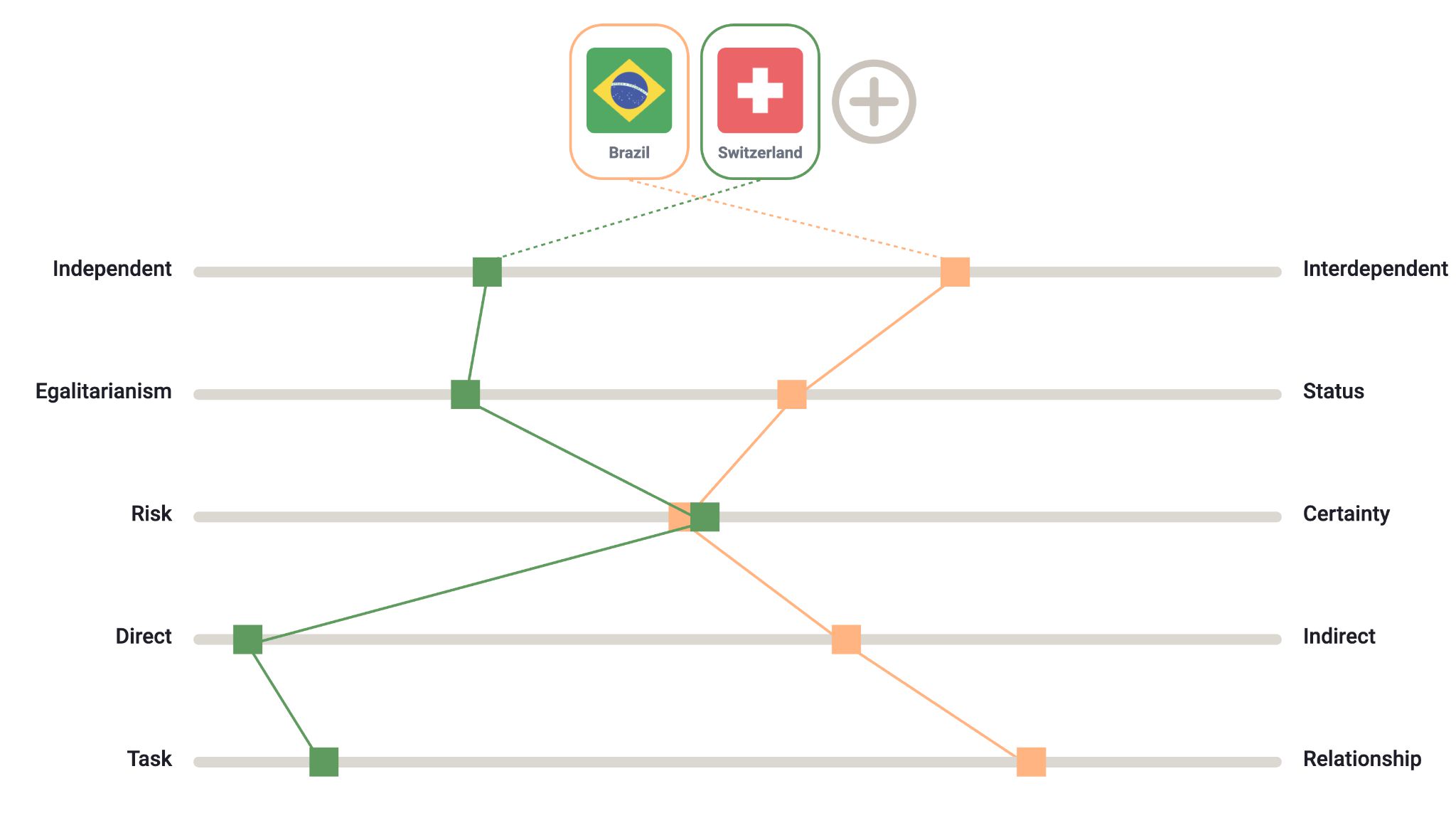
Source: Aperian, “GlobeSmart Profile.” Available at:: https://aperian.com/globesmart-profile/
From the framework above, you can see that there are significant differences between the typical Swiss and the typical Brazilian in most dimensions, with the exception of orientation toward risk.
The first dimension shows that people from Switzerland tend to make decisions more independently, valuing autonomy as an important competence and as part of individual identity. In Brazil, by contrast, identity is more closely connected to the group, and decisions are generally made collectively in order to preserve harmony and cooperation. If you make decisions by yourself in Brazil, you may be perceived as someone who does not value the group or as overly individualistic. Depending on the corporate culture, this kind of behaviour may lead to exclusion from group decisions, informal conversations, or social events. Although interdependent decision-making may require more time, conversation, and meetings, it can be more effective in generating team engagement and collaboration among key colleagues. In many cases, your transaction costs will actually be reduced if you take the time to consult people, ask for their opinions, and involve the key actors.
Brazilian culture is also more oriented toward status than Switzerland’s. This means that Brazilians often take a person’s job title and position in the hierarchy into account before expressing themselves or taking a stance. Brazilians rarely challenge their superiors openly and directly in meetings with others, unless the corporate culture explicitly allows it. To adapt effectively to Brazil, you need to be aware of the position your interlocutor holds within the company in order to avoid misunderstandings with colleagues at different hierarchical levels. If you disagree with someone at a higher hierarchical level than you, it is usually better to do so privately and indirectly, while always providing context.
In the third dimension, both Swiss people and Brazilians occupy an intermediate position in terms of risk versus certainty orientation. This reflects a tendency in both cultures to invest time in gathering data or establishing adequate procedures before making a decision. Although there are similarities in this dimension, it is important to note that Brazilians tend to be more flexible and often show a sense of urgency when changing procedures and processes that no longer meet the expectations of an important client or the demands of the market. The famous jeitinho brasileiro (Brazilian way) highlights this flexibility and this concern for people and practical outcomes. Statements such as “fixed prices” may fail to address the customer’s need to feel valued and taken seriously in Brazil.
In terms of communication, Swiss people are generally more direct than Brazilians, meaning that they tend to go straight to the point and address conflicts directly. In Brazil, by contrast, messages and feedback are usually delivered with great attention to how they will be received, in order to preserve personal dignity. A negative answer is rarely given directly and without prior explanation, as this may be perceived as rude or insensitive. Before giving individual feedback, it is a good idea to prepare your message so that points for improvement are presented positively and within a broader context. For example: “Now that you are facing more complex challenges and clearer goals, you need to prioritize your activities more carefully so that you do not miss your deadlines, as happened last month. Let’s discuss together the criteria you can use to prioritize them.” In negotiations in Brazil, negative positions may also be expressed subtly, which can make it difficult for people from other cultures to determine whether the negotiation was unsuccessful or whether more time is needed. In such cases, use a trusted local contact to help you interpret the situation, and ask questions such as: “What do you need from my company to close the deal?” or “What information do you need from us in the next few days?”
The last dimension presents a challenge for Swiss people, who often prefer to avoid talking about personal topics. Brazil is a culture in which people generally need to know you personally – your family, hobbies, or values, at least to some extent – before they fully trust you. Trust does not come only through delivery and performance, as in more task-oriented cultures, but through both relationships and results. If you want to be a productive leader in Brazil, it is a good idea to invest time in getting to know your team members, key colleagues, customers, and suppliers. This approach will help you build trust and often save time later. Unlike in Switzerland, in informal meetings – or even at the beginning of formal meetings – it is useful to talk about personal matters or share stories that reveal something about who you are. It is also worth becoming comfortable with personal questions related to family or weekends.
The journey to become an effective and inspiring leader/professional in another country is almost never easy, but it is one that can open your mind, enhance your versatility and transform you in a very meaningful way. The first step as it was mentioned at the beginning of this article is to be aware of your own preferred style in the five intercultural dimensions presented here, as well as to have the humility to understand that your own preferred style is not better than that of another culture and is not an indicator of success.
The second step is to practice freeing yourself from stereotypes that close your mind and lead you to prejudge others based on your own culture. A useful tip along this path is to avoid words such as “never,” “always,” and “everybody,” and instead use expressions such as “in my experience…,” “frequently,” or “in general.” These more open expressions leave room for others to position themselves differently and help preserve the dignity of everyone involved.
The third step is to be able to build bridges between different cultures. To exercise this capacity, it is important to understand that every culture has their own way of achieving results. Understanding your preferred style and the style of the culture you are in, it will help you define the critical points of your adaptation to the new environment. It is also a good idea to rely on local colleagues if you have doubts about how your attitude or decision might be interpreted in the new culture and whether it will be effective. With your team, one useful approach is to openly discuss the differences between your culture and the local culture using the five intercultural dimensions. This will help your team understand your behaviour and decisions, and it will also help you understand what matters most to each member of the group.
As you adapt your style to the local culture, you will be able to build third way solutions, those that are not the solution of your culture or the local, but something that brings insights of both worlds as well as creativity based on new experiences in a new context. Enjoying the journey of adaptation, you will become a more versatile professional, being able to be free of your own cultural bias and read the context and people in order to choose what will be more productive and inspirational. Certainly, to work in a different culture than yours, if you follow the steps introduced in this article, it is an experience that touches and transforms you in a very meaningful way. Using the tool GlobeSmart and participating in intercultural training, it will provide diversity, consistency and richness to your growth as a professional, as a leader and human being.
Author: Virgínia Eickhoff Haag
CEO, Virgínia Haag – Human Development and Business Strategy
Facilitator of intercultural training and mentor for expatriates
Virgínia Haag – Desenvolvimento Humano e Estratégia de Negócios